
Navigating London Taxis with Confidence and Clarity
Accessible travel across London should be straightforward, safe and dignified. In practice, disabled passengers can still face uncertainty at the kerbside, including drivers who appear unfamiliar with wheelchair procedures, vehicles that do not arrive as expected, or unlawful refusals involving assistance dogs. Understanding the rules makes it easier to plan a journey, challenge poor treatment and request the support needed for a smooth onward trip. The Transport for London accessibility guidance sets out the practical duties applying to London taxis and private hire vehicles.
The Equality Act 2010 provides the essential legal baseline. London”s licensed black taxis are designed to carry wheelchair users, while relevant rules also protect passengers using designated private hire vehicles and passengers travelling with guide or assistance dogs. Drivers may have to deploy ramps, provide reasonable physical assistance, carry mobility equipment and apply the ordinary fare without adding a disability-related charge. This guide explains what should happen, what must not happen and how to record a complaint if a journey is refused or handled unlawfully.
Statutory Protections Under Section 165 and Essential Wheelchair Access Rules
Every licensed London black cab is designated as wheelchair accessible. Under section 165 of the Equality Act 2010, a driver of a designated vehicle must carry a wheelchair user in the passenger”s own wheelchair where the vehicle and wheelchair arrangement permit it. The driver must take reasonable steps to ensure that the passenger travels safely and in reasonable comfort. This protection is not limited to passengers who can transfer into a standard seat. The purpose is to allow the wheelchair user to remain in the wheelchair during the journey where the vehicle is built and approved for that arrangement.
The driver”s duties include more than simply stopping at the kerb. Where necessary, the driver should deploy the approved ramp or other access equipment, guide the wheelchair safely into position, apply the vehicle”s restraint system and explain any relevant safety procedure. If a passenger can transfer to a seat, the driver must also carry the wheelchair or mobility aid, provided it can be accommodated safely. A pre-booked private hire driver who has been told that a disabled passenger needs help should take reasonable steps to identify the vehicle and assist the passenger in finding it.
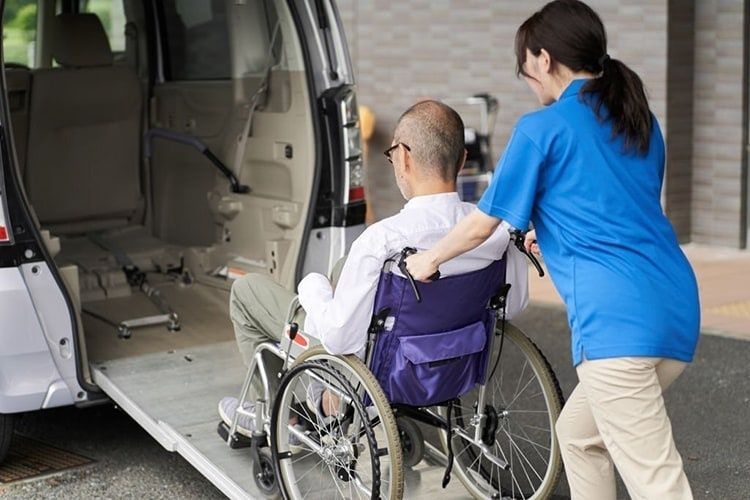
Assistance must be practical and proportionate, not rushed or treated as an inconvenience. A driver should not refuse because boarding takes longer, demand that a passenger leave a wheelchair behind without a proper safety reason, or drive away after seeing a wheelchair user waiting. The driver must not handle a passenger roughly, move a wheelchair without permission except where safety requires urgent action, or place the passenger and equipment in an unsafe position. The core responsibilities can be summarised as follows:
- Deploy the ramp or approved access equipment correctly.
- Provide reasonably required help with boarding and positioning.
- Secure the wheelchair and passenger safely before moving off.
- Carry a wheelchair or mobility aid when the passenger transfers, where it can be accommodated.
- Transport the passenger in reasonable safety and comfort.
- Avoid refusing the journey simply because the passenger is disabled or uses a wheelchair.
These duties apply to licensed services, but passengers should still check that a vehicle is properly licensed. A black cab should display its official licence information, and a pre-booked private hire vehicle should be arranged through a licensed operator. The explanatory notes to the Equality Act 2010 provisions describe how vehicle designation, driver duties and medical exemptions operate. A driver who breaches the rules may face prosecution, a fine of up to £1,000 and a review, suspension or loss of the vehicle licence.
Fair Fares and the Strict Ban on Extra Wheelchair or Mobility Charges
A disabled passenger must not be charged extra because a ramp is needed, a wheelchair must be loaded, boarding takes longer or the driver provides reasonable assistance. The normal metered fare applies to the journey. This is important for both street-hail journeys and appropriate pre-booked services: disability-related access work is part of the driver”s legal duty, not an optional premium service.
For a London black cab, the meter should not be running while the driver is deploying the ramp, helping the passenger board and securing the wheelchair. The fare should begin in accordance with the ordinary taxi rules for the journey, rather than accumulating while the passenger is waiting for legally required access assistance. A driver should also not add a separate “wheelchair fee”, handling charge, assistance charge or waiting surcharge that is directly linked to the passenger”s disability.
| What the law requires | What is not permitted |
|---|---|
| Apply the ordinary fare for the journey | Add a wheelchair or mobility surcharge |
| Provide reasonable boarding assistance | Charge for deploying a ramp or securing equipment |
| Carry the passenger”s wheelchair where it can be safely accommodated | Demand extra payment for carrying the wheelchair |
| Keep the fare process transparent | Run the meter during the access process before the journey properly begins |
Passengers should ask for a receipt where there is a dispute about the fare. Note the amount shown on the meter, any additional amount requested, the time and location, and whether the driver described the payment as a special accessibility charge. Clear records make an enforcement complaint much easier to assess. If a booking platform or operator quotes a price in advance, the quoted price must not be increased merely because the passenger uses a wheelchair or needs reasonable assistance.
Assistance Dog Accompaniment and Legitimate Medical Exemptions
Drivers must carry guide dogs and certified assistance dogs, allow the dog to remain with its owner and provide the journey without an additional charge. A driver cannot lawfully refuse because the dog is large, because the vehicle might become dirty, because another passenger objects or because the driver does not generally like animals. Private hire operators must not refuse a booking or journey on the basis that the passenger is accompanied by an assistance dog.
Refusing to carry an assistance dog is a criminal offence under the Equality Act provisions applying to taxis and private hire vehicles. The rule is designed to protect independence as well as access. A refusal can prevent a passenger from reaching work, medical appointments, school, accommodation or an airport connection. Reports of repeated refusals have also highlighted how inconsistent enforcement can leave passengers unsure where to turn. The legal duty, however, remains clear and a passenger does not have to negotiate a higher fare or find a replacement vehicle simply because a driver refuses unlawfully.
Medical exemptions are narrow. A driver may apply to the licensing authority for an exemption on medical or physical grounds, such as a properly supported allergy or condition that genuinely prevents carriage of an assistance dog. An exemption is not created by a driver”s personal assertion. Where an exemption has been granted, the driver must display the official yellow exemption notice clearly on the vehicle windscreen. Passengers can look for that notice before assuming that a refusal is legally justified.
- Check for the official yellow medical exemption notice.
- Do not accept an unsupported claim that the driver is exempt.
- Record whether the dog was wearing its working harness or identifying equipment.
- Note the exact words used by the driver and whether an alternative vehicle was offered.
- Keep booking confirmations, receipts and any messages from the operator.
Step-by-Step Protocol to Document and Report Unlawful Refusals
If a driver refuses a wheelchair user, drives away, refuses an assistance dog or demands an unlawful extra fee, safety comes first. Avoid an argument in traffic and do not attempt to block the vehicle. If possible, move to a safe place, arrange alternative travel and preserve the details while they are fresh. A calm, accurate record is usually more useful than a confrontation, particularly if the journey was booked through an operator or app.
Complaints about London licensed taxis and private hire vehicles should normally be submitted to Transport for London. A local authority may also be relevant in some circumstances, particularly where a licensing matter falls outside TfL”s direct responsibility. The enforcement process is stronger when the report identifies the vehicle and driver precisely. Use the following sequence:
- Write down the vehicle registration number and the taxi licence plate or private hire plate details.
- Record the driver”s badge or licence identification number, if visible.
- Note the date, exact time, pickup point, destination and precise location of the refusal.
- Record what happened in order, including whether a ramp was deployed, an assistance dog was refused or an extra charge was requested.
- Keep photographs of licence details, the yellow exemption notice, the vehicle and any fare display, provided this can be done safely and lawfully.
- Save booking references, app messages, receipts, call logs and witness contact details.
- Submit the complaint through TfL”s official taxi and private hire feedback or enforcement route, and request a reference number.
Use direct, factual language. Explain the access impact, identify the legal duty that appears to have been breached and state what evidence is available. If the incident involved threatening behaviour, unsafe driving or immediate danger, contact the police as appropriate. A complaint should not be abandoned because another vehicle was eventually found. Reporting helps TfL identify repeat conduct, assess driver fitness and enforce the standards intended to make London travel reliable for disabled passengers.
Empower Your Journeys Across the Capital Today
London taxi passengers with disabilities have enforceable protections, not merely voluntary customer service promises. Wheelchair users should receive reasonable boarding assistance, safe restraint and the ordinary fare. Assistance dog handlers should be able to travel without refusal or an added charge, unless a driver has a genuine, formally approved medical exemption displayed through the required yellow notice. Licensed drivers and operators are accountable for meeting these duties.
For planned journeys, share access requirements when booking, allow sensible time at airports and busy stations, and confirm the pickup point clearly. Keep the vehicle, driver and fare details if anything goes wrong. TfL”s passenger accessibility information and complaint channels are the key enforcement resources, while emergency concerns should be directed to the police. With the rules understood and records kept carefully, disabled residents, visitors, carers and assistance dog owners can arrange safer, more predictable and more dignified journeys across the capital.